


You've just finished your Certified ScrumMaster® course. You're energized, you have a framework in your head, and now you have to walk into a real team and put it to work. The gap between knowing scrum and doing scrum is where most new scrum masters struggle.
The advice in this article comes from experienced scrum masters reflecting on what they wish someone had told them at the start. Read it slowly. Come back to it often. The ideas here will mean different things to you at different points in your journey.
You are not a manager
One of the first temptations you'll face is the urge to act like a manager. When you have a bird's eye view of the team, it's natural to feel like you can see the right path forward. It’s equally natural to want to point everyone toward that path.
Resist that urge.
A manager controls activities and directs people. A scrum master does neither. Even when you're confident you know how a problem should be solved, remember that a team that solves its own problems grows stronger. A team that is handed solutions doesn't. Your perspective is valuable, but it is never more valuable than the sum of the team's knowledge. Your job is to help them find their own answers, not to hand them yours.
You are a coach
A better frame for your role is that of a coach. Not a manager, not an expert, not an authority. Scrum masters are often called servant leaders because the question they carry into every interaction isn't "What will you do for me today?" but "How can I help you today?"
In practice, that looks like four things:
Transparent communication. You help the team stay clear with each other. This includes who owns what, what's due when, where things stand. On a sports team, a coach builds communication habits so the players don't need to look to the sideline mid-game. You're doing the same thing.
Learning and development. You keep one eye on where the team is and one eye on where they could be. Professional growth doesn't happen automatically; it needs someone paying attention to it. That someone is you.
Impediment mediation. When something is blocking the team's progress, your first move is not to remove it yourself, but to help the team see it clearly and work through it. A coach doesn't step onto the field and make the play. They work with the player until the player can make it themselves. That said, if an impediment comes from outside the team and the team genuinely cannot remove it, that's when you step forward.
Trust building. You cannot tell a team to trust each other. Trust is built through shared experience, and your job is to create the conditions for that to happen. The stronger the relationships on your team, the stronger everything else becomes.
Curiosity is your biggest asset
You have something experienced scrum masters don't: fresh eyes and the natural permission to ask questions without judgment. As one scrum master puts it: “Use your newbie status to your advantage. Have fun with it.” – TJay, 2 years
Ask questions until you understand the organization. Get to know your team as people, not just their roles. Bring the energy from your CSM course into the room with you. The single best habit you can build right now is a simple one: when in doubt, ask the team and listen.
Ask for feedback regularly
Asking for feedback is uncomfortable. That doesn't make it optional.
Feedback from your team is how you grow in the role and how you help the team grow alongside you. A few questions worth asking regularly:
- What is one thing I'm doing well that I should keep doing?
- What could I do more effectively?
- How can I better support you in your work?
- What's missing — from our team, or from the organization?
- On a scale of 1–10, how are we doing?
.jpg?sfvrsn=ad395760_1 "d9Nyd-20YxcbwhNJ_jLTjbvEEWoEnY5jx (1)")
These conversations build trust. They also signal to your team that their perspective matters to you — which is exactly the kind of culture a scrum master is trying to create.
Don't take failures personally
You will pour time and thought into a new process, a retrospective format, a tool — and sometimes it will land flat. That's not a referendum on you as a scrum master. "You are not your advice, tool, or technique. You are courageous for trying something new and you are committed to the team for seeking out things that can help them. If it does not work, don't take it personally. Learn from it and grow." — Cody, 3 years
Trying something new takes courage. Bringing new ideas to a team is an act of commitment, even when the idea doesn't work. Own it when something fails, extract what you can from it, and move on. And remember you don't have to be perfect to be effective. "Through yoga and meditation, I've come to see the beauty of practice over perfection. I believe the same is true about scrum mastery. Don't worry about being perfect. Just breathe." — Molly, 1 year
Meet your team where they are
As a new scrum master, you believe in agility. Your team may not yet. Some of them may be skeptical. Some may be exhausted from previous change initiatives. Some may be grieving the way things used to work. If you're stepping in after a previous scrum master, you're also navigating the shadow of a different style.
None of that is an obstacle. It's just the terrain.
The only way to know where your team is in their scrum journey is to ask and listen. You cannot help people grow if you don't first understand where they're starting from. "Sometimes the best thing that you can do is simply ask questions and listen." — Tasha, 4 years
Active listening is more than asking good questions. It includes reading what's not being said, reflecting back what you're hearing, and making people feel genuinely understood. "The hardest thing for anyone to do is to truly listen. We get so caught up in being able to respond, we forget what people are trying to communicate to us. One of the most common frustrations is feeling unheard." — Steven, 3 years
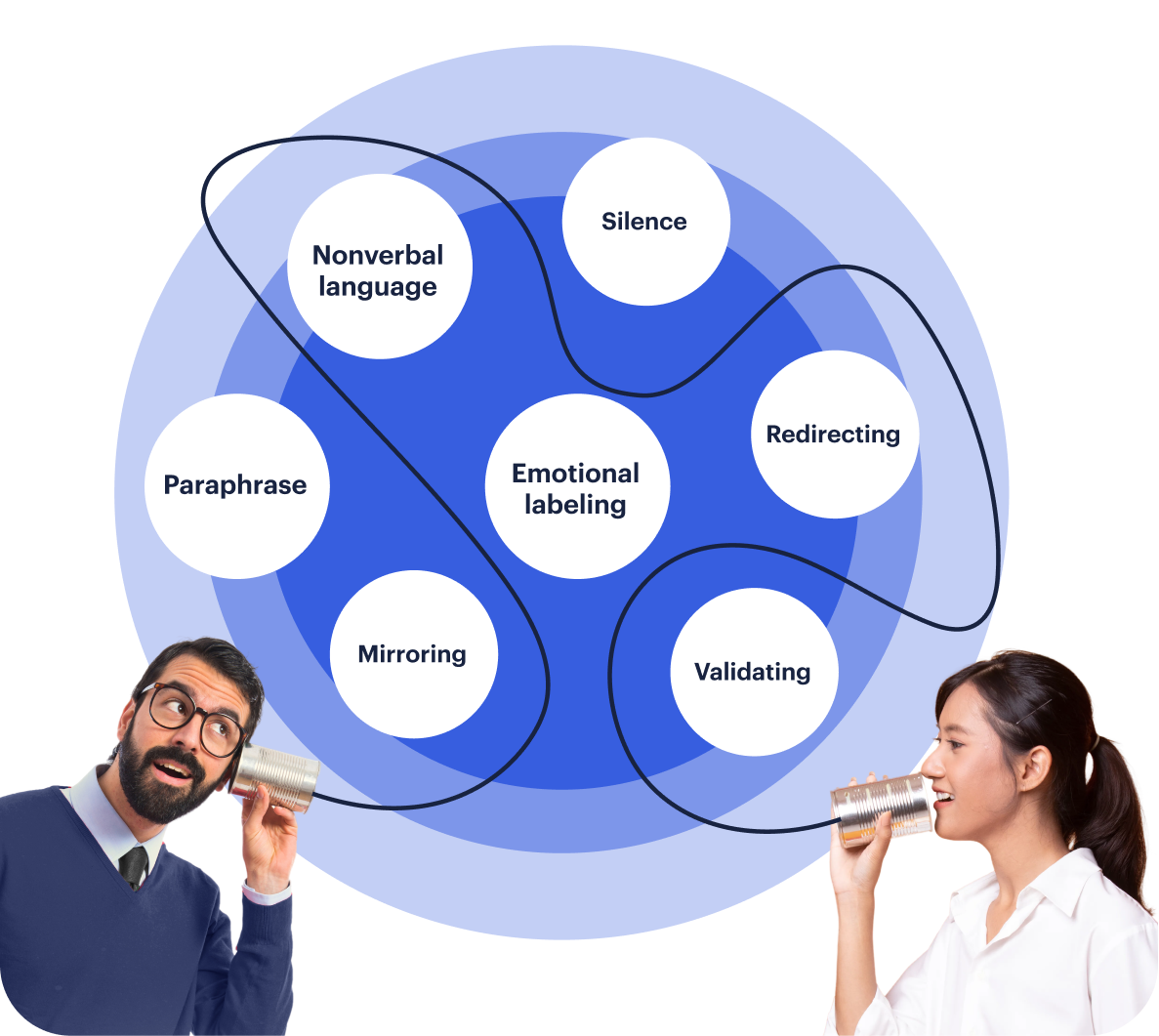
Be OK with silence after asking a question. Observe whether the team is comfortable saying no to things. The answers people give when given space are often more honest than the ones they give when rushed.
Help teams solve their own problems
When a team member brings you a problem, the temptation is to solve it. Don't.
"I've heard many times that scrum doesn't solve your problems, it shows you your problems. It's OK that problems pop up one right after another, that's expected. The best thing you can do is help your team understand and decide which problem to solve first." — Sarah, 2 years
Your job is to help the team see their impediments clearly and work through them. Focus on the most important thing to solve right now. Don't let yourself over-analyze to the point of paralysis. Questions to ask before you decide on any next step:
- What exactly is the problem, and what work is it affecting?
- Where is it coming from — inside the team or outside?
- What goal isn't being achieved because of it?
- Who can help address it?
- In what order should impediments be handled?
Brainstorm together. Empower the team to act on their own ideas, then be present to inspect the outcome with them. If the impediment comes from outside the team and they genuinely can't remove it, that's your cue to step in and advocate for them.
You have to earn the right to coach
One of the more nuanced challenges you'll face is the team member who is going through the motions — attending ceremonies, completing tasks, but never truly engaging. Compliance isn't buy-in, and you can't coach someone who hasn't chosen to be coached.
The most effective approach is a simple one: ask permission before offering guidance. A conversation that starts with "Would you be open to trying something differently?" lands very differently than one that assumes your role gives you authority over someone's behavior. It respects their autonomy, and more often than not, it opens a door that pushing would have kept shut.
Everyone arrives at scrum from a different place — different histories with management, different tolerances for change, different levels of trust. Take the time to understand where a resistant team member is coming from before you try to shift them. That understanding is the foundation of everything.
Invest in your relationship with your product owner
Of all the relationships on your team, the one with your product owner deserves particular attention. A strong scrum master–product owner relationship is the foundation on which high-functioning teams are built. Don't take it for granted.
Spend time understanding how your product owner works, what pressures they're under, and what they need from you. Some questions worth exploring early:
- What challenges do you face when prioritizing the backlog?
- What problems keep coming up?
- What conversations can I help facilitate?
- What do you need from me right now?
The better you understand your product owner, the better you can coach them and help them work effectively with the team and stakeholders.

Small changes compound more than you think
You are an agent of change. But just because change is needed doesn't mean everyone is ready for it at the same pace you are.
Real change happens in small increments. One person. One habit. One conversation that shifts something slightly. The power of scrum is that those small changes compound over time in ways that are hard to see at the moment.
When you feel like you're not having enough impact, reframe the question:
- What difference did I make today?
- How did I help someone feel more supported this week?
- What communication did I encourage that moved something closer to done?
Work within your sphere of influence and trust that the effects will ripple outward. Connect the changes you're asking for back to why the organization adopted scrum in the first place. And remember — not everyone will get on board. Spend your energy coaching the people who want to be coached, not chasing the ones who don't.

"I recognize now that our actions today may not bear fruit today. I have had the privilege of speaking with former colleagues from years ago who told me that my work impacted them much later. Sometimes circumstances have to change for the seeds to sprout, but they still do." — Melissa, 11 years
The best scrum masters never stop being students
There is far more to scrum mastery than running ceremonies well. For example, one coach/scrum master stated: "I wish I had known more about professional coaching. As I've learned more about it, it has informed nearly everything I do as a scrum master." — Teddy, 18 years
As you grow in the role, that development becomes the work. Look beyond your team for professional development. Learn from other scrum masters. Share what you're learning with newer ones. When you're ready to go deeper, Scrum Alliance offers two certifications beyond CSM® — Advanced Certified ScrumMaster® and Certified Scrum Professional®-ScrumMaster — and a growing catalog of microcredentials that can be completed in a couple of hours.
—
The journey from new scrum master to confident one isn't a straight line. It's iterative — which, if you think about it, is exactly what scrum would predict. Keep asking questions, keep listening, and trust the process you're helping to build.