





Reviewed by Madhur Kathuria, CST®
Key Performance Indicators (KPIs) are essential metrics for demonstrating value to stakeholders and understanding whether your efforts and work are getting you closer to identified goals.
If you're a product owner or product manager, knowing the right way to identify and communicate KPIs to your stakeholders will make the difference between claiming your product will be successful and actually proving its success.
In product management, KPIs are measurable signals that show whether your product is delivering value, growing sustainably, and moving toward strategic goals. Great PM KPIs balance customer value, product usage, and business outcomes—not just vanity metrics.
In this article, we'll dive into different types of KPIs that prove product value, how to identify the types of KPIs that will work best based on your situation and goals, and how to use them effectively so they don't become another meaningless metric.
What are KPIs in product management?
When you're in charge of a product's performance, you need to measure many factors, so choosing the right KPIs depends on your goal. KPIs in product management help you deliver concrete evidence that your product is satisfying customers and meeting financial, operational, and strategic objectives.
Let's say you work for a software company, and one of the company's strategic goals is to increase customer satisfaction scores by 5 percent.
As a PM for a mobile expense-tracking app used by small business owners, you want to do your part to improve customer satisfaction. Users recently complained that the manual receipt upload process is slow. You release a new feature that automatically scans receipts. Now you want to measure whether the feature is actually improving the user experience.
Before releasing the new feature to all customers, you establish the following KPI:
Increase the customer satisfaction score for the AutoScan feature from 78% to at least 85% within 60 days by improving scan accuracy and processing speed.
By surveying users before and after the release of the new feature to establish a baseline, you can provide concrete evidence that it significantly improved customer satisfaction.
As a product professional, you must align product goals with the company's business objectives set by leadership to prove you're making valuable contributions to the team, and by choosing the right KPIs, you'll be able to make that connection quickly and easily.
Why KPIs matter in product management
As a product management professional, you play an essential role in your company, ensuring that the products you deliver to market make a difference to customers and support the company's goals.
When you know how to use KPIs effectively, you've unleashed a vital tool for decision-making. It could mean you abandon a bad idea quickly rather than spend months trying to deliver a product that doesn't move the needle. Or you learn soon that a sample group of users is delighted with a new feature, so that you can use that knowledge to distribute it to more users quickly.
Measuring KPIs helps with the critical task of prioritization. If you've set a KPI for financial performance but learn that the product isn't performing as expected, you know to de-prioritize any additional features you planned to release. This saves significant time and money and allows you to focus on the work that matters.
If you've ever worked on a team or for leaders who are output-oriented, using KPIs can help. Instead of focusing on how many tasks were completed, KPIs show outcomes of the work. Your team can be really busy, but if the work isn't meeting business goals, your credibility will ultimately be at risk.
By agreeing on KPIs upfront with your stakeholders, everyone is on the same page about what success looks like, so you're not fighting an uphill battle to defend your product.
Types of KPIs in product management
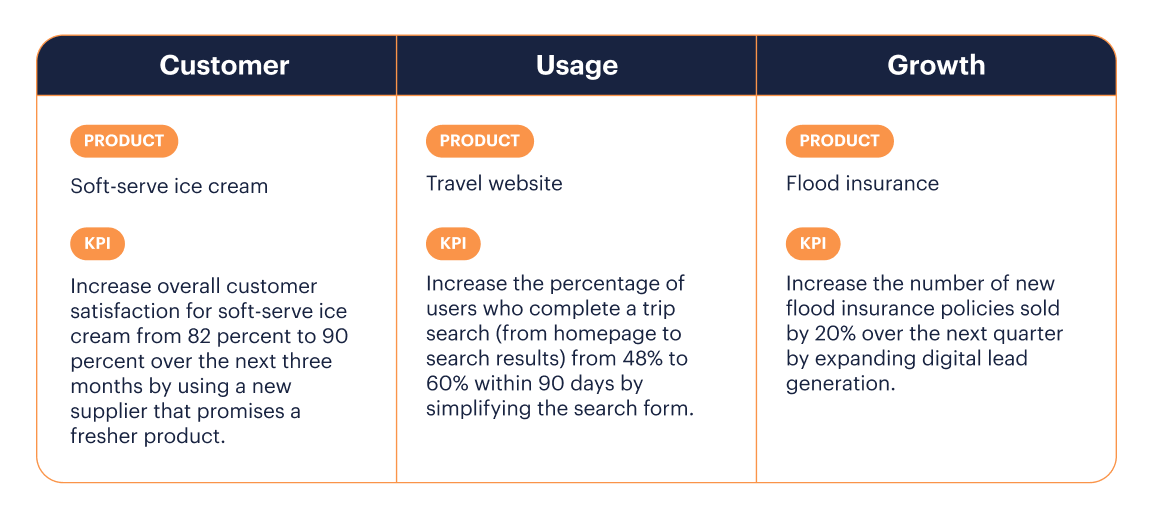
There are many ways to measure KPIs in product management, depending on what goal you're trying to accomplish. To get started, bucket KPIs into these general categories:
- Customer – Are customers happy?
- Usage – Are customers using the product as it was intended?
- Growth – Are we gaining more customers?
- Financial – Is the product making money and helping the company achieve its financial goals?
- Operational – Are we delivering a quality product?
- Strategic – Are we achieving our long-term strategic business goals
Here are some examples to get you started:
How to define KPIs for your product
Establishing product KPIs works best when it's a collaborative process involving your stakeholders. Set up regularly scheduled working sessions, such as quarterly planning sessions, to align first and foremost with the organization's business goals.
Once high-level business goals have been agreed upon, you can dive into the plans for your product in the coming quarter. It's best to come prepared with data-driven ideas and encourage an open conversation.
For example, you may share that your travel company's website is getting a lot of traffic but few searches, and that you believe simplifying the search form will improve conversion rates.
Working as a team, you realize that the metric you are after is usage. Together, you write a few different KPIs and finally settle on the one that feels most impactful.
Best practices for tracking and using KPIs
To get the most out of your KPIs, it's important to track progress along the way, regularly review updates with stakeholders, and set up performance metrics in a collaborative shared workspace, such as a dashboard or project management tool.
Successful KPIs begin with a benchmark of where you are right now, so if you haven't been keeping track, that's your first step. Using the soft-serve example, you could establish a customer satisfaction benchmark by conducting a customer survey that can be scored mathematically.
Once a benchmark is established, your target is the improvement you'd like to see from the action you're taking on the product. While there's no magical mathematical formula here, it's best to set attainable, realistic incremental improvement. Rather than trying to get a 50 percent improvement in a year, aim for a 5 percent improvement in a few months.
Finding the right metrics for your team
KPIs are a product professional's best-kept secret (well, the secret's out now!) for understanding whether your efforts are getting you closer to your goals. When you use KPIs instead of vanity metrics, you're showing outcomes that matter instead of busy work that often proves meaningless.
With Scrum Alliance's collection of data-driven courses, you can upskill in KPIs, OKRs, and other metrics designed to increase your own personal performance as well as your team's. You'll earn a lifetime microcredential badge and a two-year membership with premium Scrum Alliance benefits.
About the author

We’re committed to equipping professionals and their organizations with the education, skills, and community needed to succeed in today’s ever-evolving workplaces.