



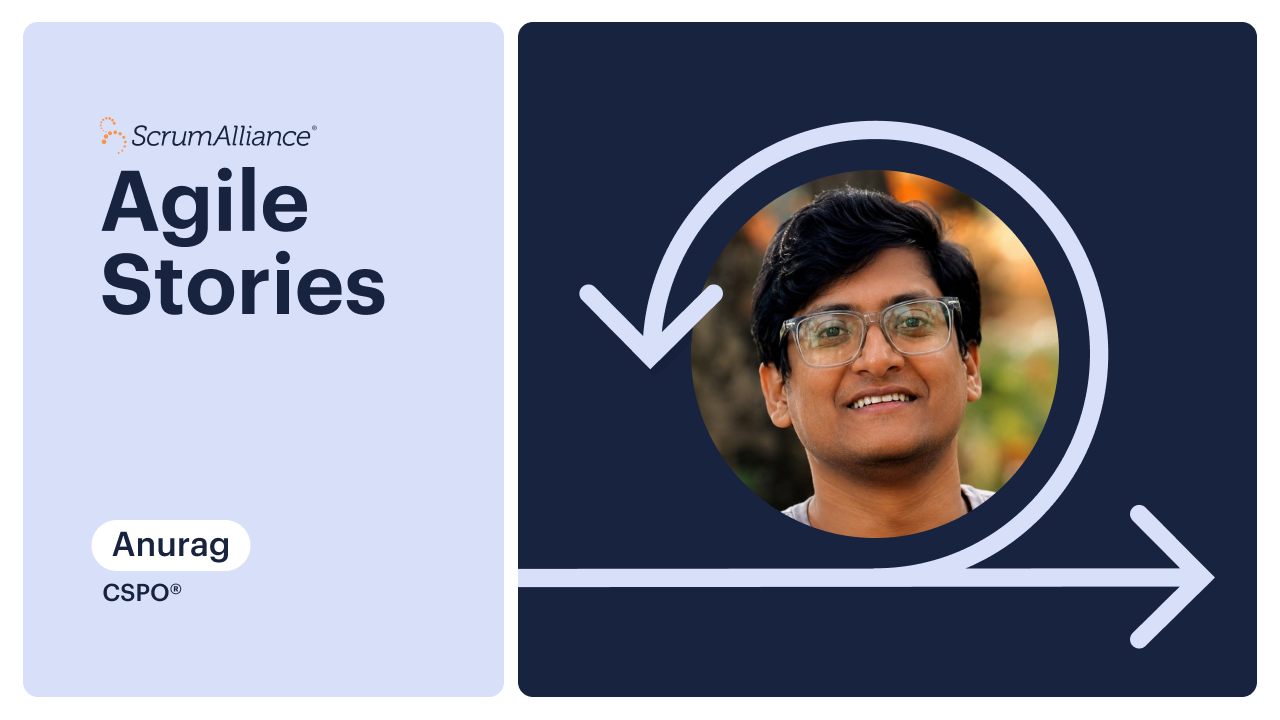

The most meaningful career transformations rarely happen in a straight line. They tend to unfold at the crossroads of disciplines, where the skills you've built in one domain start to reshape how you think in another. For Anurag Srivastava, that intersection is where everything clicked.
Anurag is a Product and Enterprise UX Strategist with deep experience in digital transformation across B2B SaaS, fintech, and enterprise platforms. His career has taken him from software engineering to UX design to product strategy, and along the way, he's built something harder to teach than any single skill: a way of thinking that bridges all three.
In this member spotlight, we explore how earning his Certified Scrum Product Owner® (CSPO®) certification reshaped his approach to product work, how he's navigating the rise of AI through an agile lens, and what it means to treat agility as a mindset rather than a methodology.
How the CSPO unlocked a new way of thinking
Anurag didn't pursue his Certified Scrum Product Owner certification to check a box. He pursued it because he saw a gap. He had a strong foundation in engineering and UX, but he wanted a clearer framework for connecting those disciplines to business goals and delivery teams.
The CSPO gave him exactly that. It introduced him to the language and structure of product ownership, helping him move beyond delivering outputs and toward maximizing value. That shift, from "what did we build?" to "what did we achieve?", changed the way he approaches every project.
"I came to the CSPO already fluent in design and frontend engineering. What it added was the third lens—learning to ask not 'can we build this well?' but 'should we build it at all, and for whom?'" Anurag explains.
That reframe is deceptively simple. But in complex enterprise environments, where teams are large, stakeholders are many, and priorities compete constantly, it's a distinction that makes all the difference.
The principles he comes back to, every single day
Ask Anurag which agile principles have shaped him most, and he'll point to four, the same four he applies consistently regardless of the project or team:
- Customer-centricity: Every decision should trace back to a real user need. In enterprise product work, it's easy to get lost in internal processes, technical constraints, and business politics. Anurag uses customer-centricity as his anchor.
- Prioritization: Not everything that could be built should be built. And not everything important should be built right now. Prioritization, done well, is one of the highest-leverage skills a product owner can have.
- Incremental delivery: Shipping in smaller, meaningful chunks creates faster feedback loops and reduces the risk of building in the wrong direction. Anurag sees this as non-negotiable in environments with high complexity.
- Continuous feedback: Products improve when teams listen, not just at launch, but throughout the entire lifecycle. Building feedback mechanisms into the process, rather than treating them as afterthoughts, is how good products become great ones.
Together, these principles reflect an outcomes-over-output philosophy. In enterprise settings, where complexity can easily obscure what actually creates value, clarity of purpose is essential.
Delivering products that make complex things simple
Of everything Anurag has accomplished in his career, one achievement stands out: delivering enterprise products that genuinely simplified complex workflows and improved the day-to-day experience for the people who use them.
That kind of work is harder than it sounds. Simplifying complexity requires a rare combination of technical fluency, design intuition, and product judgment. You need to understand how systems work, how users think, and how business goals constrain or enable both. Anurag's cross-disciplinary background in engineering, UX, and product strategy gives him all three.
"In the AI era, building has never been faster or cheaper," he said. "That makes the product owner's question the most valuable one in the room: not 'can we build this?' but 'does it deserve to be built, and for whom?'"
Agility in the age of AI: how does agile help teams work with AI?
AI is changing the texture of product work. Research that once took days can now take hours. Prototyping is faster. Content creation, data analysis, and even parts of development are accelerating. For product teams, the implications are significant.
Anurag's take is grounded and clear: as building gets easier, judgment becomes more important, not less. AI can accelerate execution, but it can't decide what's worth building. It can generate options, but it can't determine which option actually serves the customer. That's still a human job, and it's the job that agile frameworks are built to support.
Agile team principles, including experimentation, transparency, and continuous learning, create a natural foundation for thoughtful adoption of AI. Teams already comfortable with iteration and feedback cycles are better positioned to test AI tools, learn from the results, and adjust course quickly. That's not a coincidence. It's what agility is designed to do.
Anurag frames AI as an enabler. It expands what's possible. But the role of the product owner—to define value, prioritize ruthlessly, and keep the team focused on outcomes—remains just as crucial as ever. Perhaps more so.
What agility means: a mindset, not a methodology
The deepest lesson from Anurag's career isn't about any single certification or framework. It's about what agility actually is.
That distinction matters, especially now. As AI reshapes what product teams can accomplish, the temptation is to chase speed and features. Anurag's perspective points in a different direction: in a world of accelerating capability, simplicity and customer value matter more than ever. The teams that win won't necessarily be the fastest. They'll be the ones with the clearest sense of what they're building and why.
The Scrum Alliance community understands this. Agility has grown beyond specific roles and frameworks. It's an evolving practice, shaped by the people who live it every day, including practitioners like Anurag who bring new disciplines and new questions to the table.
Agility as a career-long practice
Whether you're a UX designer wondering if product ownership is in your future, an engineer looking to bridge the gap between technology and strategy, or a seasoned practitioner navigating the changes AI is bringing to your work, the mindset of continuous learning and adaptation is the thread that connects it all.
The Certified Scrum Product Owner certification can be a powerful catalyst for that kind of growth. It's not just a credential. It's a new lens for seeing your work, one that many practitioners, including Anurag, describe as genuinely transformative. Learn more about the CSPO.
What's your agile story? We'd love to hear it. Share your journey with the Scrum Alliance community, or explore how Scrum Alliance membership and certification programs can help you take your next step.
About the author

We’re committed to equipping professionals and their organizations with the education, skills, and community needed to succeed in today’s ever-evolving workplaces.