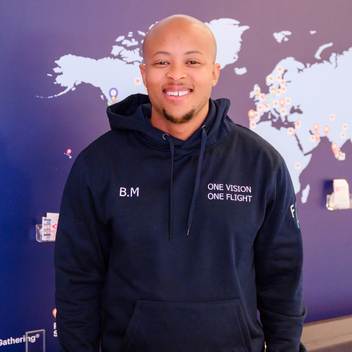


In March 2025, I attended the Regional Scrum Gathering (RSG) in Cape Town as a participant. At the time, I was a Project Manager working in financial services—not an agile coach, not a trainer, and honestly, not someone who identified primarily with the agile community.
I attended because the problems I was solving at work felt like challenges others in the room might recognize: specifically, translating complex technology delivery into language that boards and executives could actually act on. I left that event with a much clearer sense of what was missing from the conversation—and a growing certainty that I was the one who could bring it to light.
Less than a year later, I stood on stage at the Global Scrum Gathering (GSG) in Vancouver delivering a session called "Why Your Board Doesn't Care About Story Points (And What to Show Instead)." The session generated incredible feedback in emails and LinkedIn messages from fellow professionals who recognized the exact problem I had named.
The path between those two moments—moving from a back-row seat to a main-stage speaker—holds valuable lessons for anyone wondering if they have something worth saying on a global stage.
What motivated my proposal to speak at GSG
My decision to submit a speaking proposal didn't actually begin with RSG Cape Town. I had wanted to present at a conference for some time, but I had a strict threshold: it had to be worth the audience's attention. I wanted to share something meaningful that added genuine value or raised questions the community needed to sit with. In October 2025, I concluded that I finally had that something.
What crystallized for me at RSG Cape Town was the exact shape of the gap in our community:
The disconnect: The conversations happening in the agile community—valuable as they were—weren't reaching the terrain where I spent most of my working life: the interface between delivery practitioners and executive decision-makers.
The unspoken challenges: Scrum masters, product owners, and project managers navigating board and ExCo engagement face practical challenges that rarely surface in conference sessions. How do you show up in those rooms? What does an executive actually need to hear—and what do they need you to leave out? And crucially, what does working at that interface teach you about the kind of leader you might eventually become?
These were conversations worth having, and my proposal was the vehicle to start them.
My lesson for prospective speakers: A proposal doesn't need to introduce a brand-new framework. It needs to name a conversation the community hasn't had yet—or hasn't had honestly. Our industry intersects with multiple ways of working and delivery models. Scrum outputs remain important, but at certain executive levels, they need to be translated, not abandoned. As practitioners closest to that translation challenge, we are often the ones best placed to speak about it. The bar isn't novelty; it's substance.
Behind the scenes: How I prepared for a global stage
The distance between getting a proposal accepted and delivering the actual session is much greater than most first-time speakers anticipate. For my Vancouver session, my preparation spanned three months and followed a deliberate structure:
- Grounding content in reality: Every example in my deck came from actual steering committee presentations I had delivered—what I showed to executives, how they responded, what I changed as a result, and what my team learned about executive communication in the process. Because it was based on real program experiences and not hypotheticals, my session could withstand the "did you actually do this?" test that experienced audiences apply instinctively.
- Building a through-line: I built my deck around an altitude metaphor that moved the audience from ground-level delivery metrics up through team-level indicators to board-level strategic framing. This gave the session a narrative arc rather than just a list of tips. Audiences remember stories structured around a single organizing idea far better than they remember slide decks structured around categories.
- The leadership litmus test: Three weeks before the event, I conducted an internal dry run with my organization's C-Suite. This was not optional. Presenting to senior executives who challenged my content on substance (not just presentation delivery) forced a level of rigor that a practice run with peers alone would not have achieved.
If you are a first-time speaker, I highly recommend seeking out the toughest audience available for your rehearsal. The actual stage will feel much easier by comparison.
Regional vs. global gathering: what's different?
The most immediate difference is scale. A regional gathering has the intimacy of a community event—you see the same faces across sessions, conversations carry over from one coffee break to the next, and the local context is shared. A global gathering is larger, faster, and more diverse. The audience in any given session may include practitioners from six or seven countries, working in industries that share no common regulatory or organizational context.
For a speaker, this changes the preparation calculus. At a regional gathering, local examples land naturally—the audience understands the institutional landscape, the regulatory environment, the cultural norms around hierarchy and decision-making.
At a global gathering, every example needs to be accessible without that shared context. The underlying principle must be universal even if the illustration is specific.
The Vancouver session drew on my experiences from a South African financial services environment, but the core insight—that executives make funding and governance decisions based on strategic risk narratives, not delivery metrics—resonated with practitioners from North America, Europe, and Asia-Pacific equally.
The energy is also different. A regional gathering feels like a conversation among colleagues. A global gathering feels like joining a movement. The exposure to practitioners working in radically different contexts—healthcare systems, defense programs, public sector transformation, startup ecosystems—stretches assumptions about where and how agile principles apply. That exposure alone is worth the journey, whether or not you are speaking.
Why the community needs practitioners from outside the usual centers
The global agile community has historically drawn its speaker base disproportionately from North America and Western Europe. This is understandable—these are the geographies where the frameworks originated and where the commercial ecosystem is deepest.
But it means the community's collective knowledge skews toward a narrow set of organizational cultures, regulatory environments, and delivery contexts.
Practitioners from emerging markets, from heavily regulated industries, from organizations where agile is being adopted inside legacy governance structures rather than greenfield environments—these voices carry insights that the community cannot generate from within its existing speaker base.
The challenge of translating agile delivery into executive language is amplified in environments where board governance is formal, hierarchical, and risk-averse. Solutions forged in those environments are often more robust and more transferable than solutions developed in organizations where agile fluency is already the norm.
For practitioners in those contexts who are considering submitting a proposal: the community is actively looking for your perspective. The barrier is not whether your experience is relevant. It is whether you recognize that the problems you solve daily—problems that feel ordinary to you—are genuinely novel to practitioners working in different environments.
My advice for first-time speakers
- Start with a problem, not a solution. The strongest proposals articulate a tension the audience feels but hasn't resolved. If the problem statement makes a practitioner nod before they've read the description, the proposal is on the right track.
- Ground everything in lived experience. Audiences at gatherings are sophisticated—they can distinguish between a practitioner who has done the work and a presenter who has assembled a talk from secondary sources. Use your own program, your own steering committee, your own failures. Specificity builds credibility.
- Rehearse with people who will challenge the substance, not just the delivery. Polished slides and confident pacing cannot compensate for thin content. Find the sharpest critic available and present to them first.
- Build a through-line. A single organizing metaphor or narrative thread gives the audience something to hold onto across 60 or 90 minutes. Without it, even strong content fragments into a collection of observations that are difficult to recall after the session ends.
- Finally, attend a regional gathering before you speak at a global one. The regional gathering is where the community becomes real—where the conversations, the energy, and the generosity of practitioners sharing hard-won knowledge first become tangible. That experience is what transforms a conference attendee into someone who believes they have something to contribute. And they are almost always right.
–
Ready to make a bigger impact in your organization? Attending a Scrum Alliance event equips you with the advanced skills to solve complex workplace challenges, while embedding you in a powerful professional network of peers and leaders. Advance your career and lead with influence.
Find your next Scrum Alliance event today and unlock the connections that will elevate your professional impact.
About the author