




Executive leadership is experiencing a fundamental shift. Technology decisions around AI are no longer isolated within IT departments. Instead, those decisions sit at the heart of corporate strategy, workforce planning, and competitive survival.
The core executive challenge isn't so much acquiring the right technology as it is managing organizational adaptation as part of an AI implementation strategy. As AI reshapes work across software development, product management, and enterprise operations, leaders must balance rapid innovation with data security, compliance, and team alignment.
Leading AI transformation successfully requires moving beyond top-down mandates toward organizational agility.
The strategic executive mandate: Value, ROI, and risk
The primary failure point of executive-led AI initiatives is mistaking adoption rates for value creation. Purchasing enterprise licenses across product teams does not guarantee return on investment.
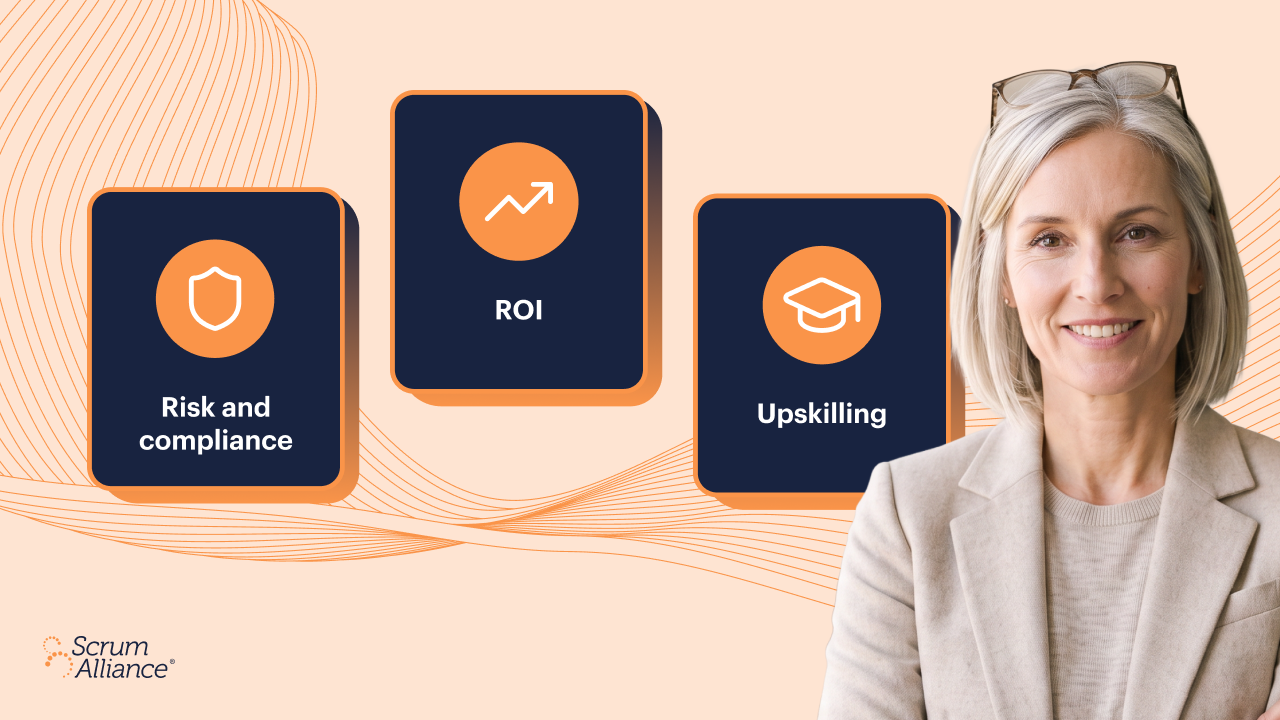
To drive sustainable enterprise AI transformation, executives must focus on three core strategic pillars:
- Risk and compliance management: AI models trained on proprietary data present real intellectual property, privacy, and regulatory risks. Executives must partner with security and legal teams to implement non-negotiable guardrails: zero-data-retention API agreements, automated Personally Identifiable Information (PII) scrubbing, and clear risk tiers for public vs. internal AI tools.
- Measuring genuine ROI: Shift focus from vanity metrics (such as daily active users for an AI assistant) to delivery metrics, including reduced cycle time from backlog to production, stable or improved defect rates, and operational capacity gains.
- Workforce upskilling: Reinvest the time saved into training teams in critical thinking and evaluation of AI outputs, domain oversight, and context engineering, rather than simple task replacement.
Upskilling and reskilling the AI-augmented workforce
AI transforms business responsibilities. Repetitive tasks—data synthesis, boilerplate documentation, initial code drafting—are increasingly automated, changing the skills required for high-performing teams.
Executives must fund and structure continuous upskilling initiatives that emphasize core human capabilities:
- Critical thinking and domain oversight: Teach teams to audit, validate, and refine machine-generated output for strategic, ethical, and architectural integrity.
- Context engineering: Help product owners and business analysts write structured, context-rich prompts to generate better market analysis, stakeholder communications, and work item details for product teams including user stories and acceptance criteria.
- Cross-functional collaboration: Equip teams to operate smoothly across product management, engineering, and data science as technological boundaries shift.
Leading transformation with agile principles
Deploying AI across an enterprise in a single, rigid, multi-year plan carries high risk. Models, capabilities, and market conditions change far too quickly for traditional waterfall deployment models.
Agile frameworks like scrum provide the exact structure required to navigate this uncertainty:
- Short feedback loops: Run AI adoption strategies in short, measurable sprints. Test small AI integrations within pilot scrum teams, evaluate the impact on product value delivered and quality, and adapt the strategy based on real performance data.
- Psychological safety and experimentation: When executives model curiosity and treat early AI setbacks as learning opportunities, they create the psychological safety teams need to experiment responsibly.
- The role of agile coaches and scrum masters: Leverage your scrum masters and agile coaches as primary change agents. They are uniquely positioned to help teams integrate AI assistants smoothly into backlog refinement, sprint planning, and their daily work without disrupting workflow.
Executive action plan for AI leadership
- Identify 2–3 strategic pilot teams: Focus initial AI integration on high-leverage product or engineering groups operating within established scrum teams.
- Establish guardrails: Implement enterprise API security agreements and PII filters to protect company IP and customer data before opening access.
- Focus on flow: Measure results through agility metrics such as improved team cycle time, product quality, and employee satisfaction rather than raw tool adoption rates.
Frequently asked questions
What is the executive's role in enterprise AI adoption?
Executives set the strategic vision, establish security and ethical guardrails, align investments with clear business outcomes, and foster a culture of continuous learning and agility.
How does an agile mindset accelerate AI strategy execution?
An agile mindset treats AI adoption as an iterative journey. By testing use cases in small pilots with existing agile teams rather than a single enterprise launch, organizations reduce financial risk and adapt as their AI implementation evolves.
Lead AI transformation with confidence
AI is changing how we work, and you don't have to navigate it alone. The organizations winning with AI are the ones building agility into how they operate, and that starts with equipping your people. Provide teams with the practical, adaptable skills to lead AI transformation with confidence. Browse Scrum Alliance AI & Emerging Practices courses today.
About the author

We’re committed to equipping professionals and their organizations with the education, skills, and community needed to succeed in today’s ever-evolving workplaces.